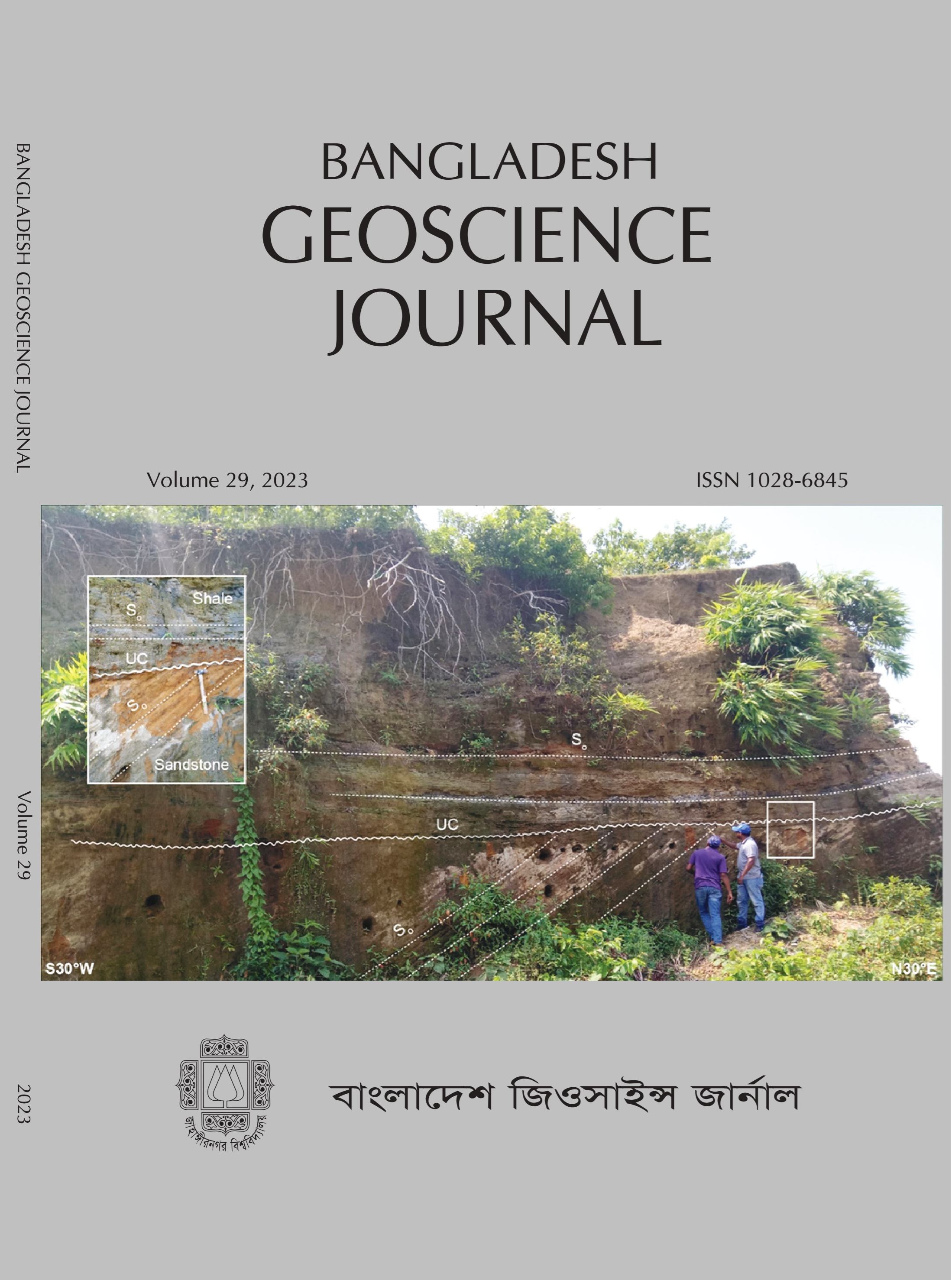
Petrography and Heavy Mineral analysis of the Dupi Tila sandstones from the Bijaipur area, northwest Sylhet Trough, Bengal Basin: Implication on Provenance Interpretations
DOI:
https://doi.org/10.59185/bgj.v29i1.188Keywords:
Quartzarenites, heavy mineral assemblages, craton, Shillong PlateauAbstract
This research investigates the Dupi Tila Formation, the youngest Tertiary stratigraphic unit in the Bengal Basin, focusing on its mineralogical composition and geological significance in the Bijaipur area of the Netrokona District, Bangladesh. Mineralogically, the sandstones are primarily composed of quartz (average 87.88%), with subordinate feldspar (average 1.34%) and lithic grains (average 0.57%), and therefore, categorize the sandstones mainly as quartzarenites, differentiating them from sandstones of this formations in other part of the Bengal Basin. The study suggests that the sediments originated from eroded cratonic rocks and were influenced by climatic conditions characterized by high temperatures and humidity, which facilitated significant weathering processes. Heavy mineral analysis indicates low overall concentrations with zircon, amphibole, and pyroxene being the most abundant, reflecting a range of igneous and metamorphic parent rocks. The high amount of quartz and ZTR indices in these sandstones reveal a relatively mature sediments, which probably the results of severe chemical weathering of parent rocks. In addition to framework mineralogy, the presence of diverse heavy mineral suites indicates complex geological histories involving collision orogen settings. Such observations help to find the link with the uplift history of the Shillong Plateau during late Pliocene–Pleistocene time which is the result of ongoing tectonic interactions among the Indian-Eurasian plates.